In an industrial ecosystem where machinery OEE (Overall Equipment Effectiveness) has been optimized to the brink of its technical limit, residual variability and efficiency losses are hidden almost exclusively in the human factor.
For industrial engineers and plant managers in high-precision sectors —such as electronics, Tier-1 automotive or medical devices— the challenge of 2025 is clear: traditional time study is dead for short cycles. When cycle time drops below 0.8 minutes, the "stopwatch" methodology is incapable of capturing the reality of the process.
The only way to reduce cycle times without compromising quality or ergonomics is Forensic Method Engineering: the atomic breakdown of manual work into its 17 (or 18) fundamental movements, known as Therbligs.
This article breaks down Confidential Technical Report TE-13, revealing how to transform work measurement through the segregation of micro-movements and the use of MTM (Methods-Time Measurement) systems.
The Collapse of Traditional Time Study in Micromechanics
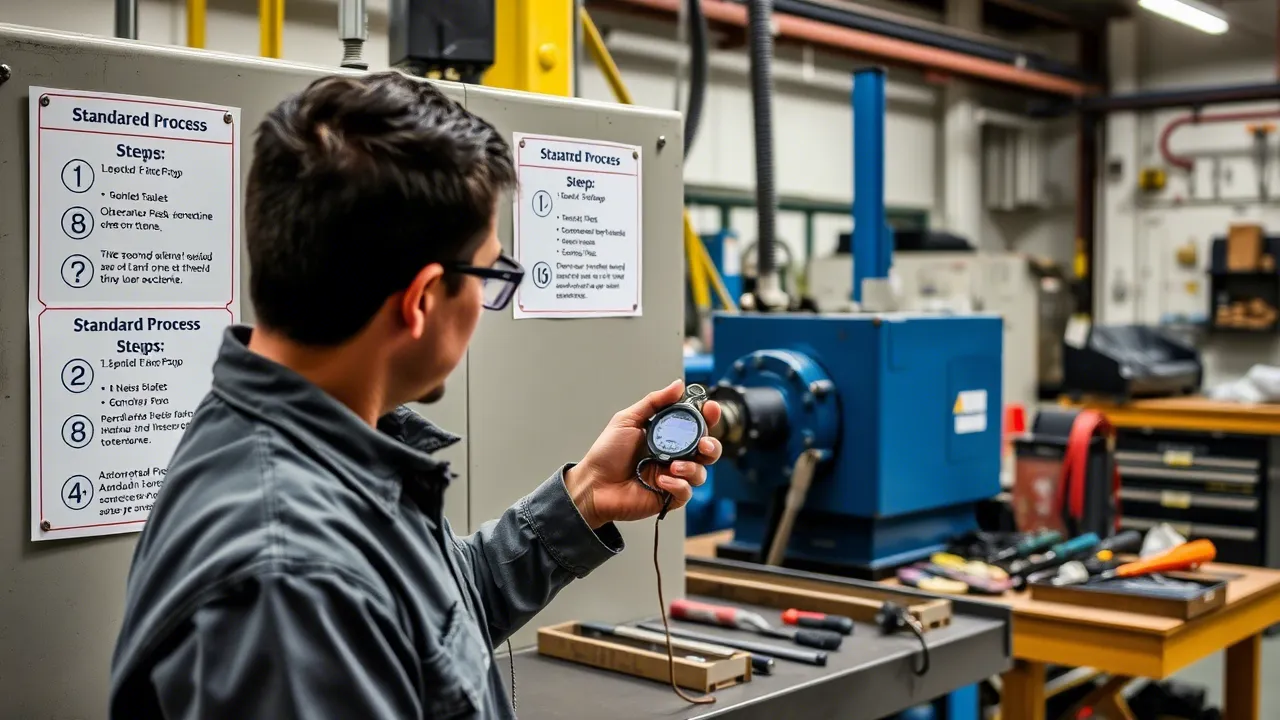
Attempting to optimize a fine assembly line with a stopwatch and a performance rating table (Pace) is technical negligence in the current scenario.
Physiological Limitations of the Analyst
The human eye has a critical perception latency. It is physically impossible for an analyst to consistently capture time intervals below 0.04 minutes (2.4 seconds). In fine assembly, where a "Grasp" (G) movement can last milliseconds, conventional time study introduces an unacceptable statistical error.
Technical Definition of Fine Assembly
To apply Technique #13, we define the work environment under the following critical conditions:
- High Repetitiveness: Short cycles (< 0.8 min).
- High Visual Load: Need for constant focus.
- Micromechanics: Handling of components with dimensions < 10mm.
The Risk of Subjectivity (Rating)
Without a predetermined time system (PTS) such as MTM-1 or MOST, rating "Activity" or "Pace" in high-skill tasks becomes subjective. An operator may appear fast by moving their hands quickly, while actually generating technical waste. Technique TE-13 eliminates this subjectivity: standard time is a function of the method, not of apparent speed.
Anatomy of Technique #13: Segregation of Efficient vs. Inefficient Therbligs
The concept of Frank and Lillian Gilbreth is not ancient history; it is the fundamental basis of Cobot programming and current MTM standards. Technique #13 is based on an unforgiving binary classification of movements:
1. Value-Added Therbligs (Progress)
These are the only ones the customer is willing to pay for, since they physically transform the product or advance the operation:
- Grasp (G - Grasp): Take control of the object.
- Assemble (A - Assemble): Join two parts.
- Use (U - Use): Handle a tool.
2. Waste Therbligs (Fatigue)
They add no value to the product; they only add time and ergonomic load to the operator:
- Search (Sh - Search) and Select (St - Select).
- Hold (H - Hold).
- Inspect (I - Inspect) (unless it is a defined critical-quality operation).
Mathematical Objective: Maximize the density of Value-Added Therbligs within the total Cycle Time, driving Waste Therbligs to zero.
[Suggested Visual Element: Pie chart comparing "Cycle Time Distribution: Value Added vs. Inefficient Therbligs (Before and After)"]
The 3 "Vampires" of Cycle Time in Fine Assembly (Field Data)
According to the data analysis of report TE-13, 40% of the time on non-optimized lines is lost to three critical inefficiencies.
1. The Hidden Cost of Search (Sh) and Select (St)
- Root Cause: Chaotic layout of bulk materials and lack of gravity feeding.
- Cognitive Impact: These are "Mental Therbligs". They increase cognitive load and visual fatigue, penalized by the Occupational Risk Prevention Law (PRL) and the new psychosocial risk regulations.
- Technical Solution: Apply the Fixed Location Principle. The part must never be "searched for"; it must appear at an exact point (vibratory or gravity feeders). If the eye has to travel to find the part, the method is wrong.
2. Position (P) and the Tolerance Penalty
In MTM systems, not all positionings are equal.
- MTM Data: There is a difference of up to 5.6 TMU (Time Measurement Units) between a Class 1 positioning (loose/no pressure) and a Class 3 one (exact fit/pressure).
- Tooling Engineering: The methods engineer must collaborate with tooling design to implement conical guides and physical Poka-yokes. The objective is to reduce the movement "Class", allowing smooth assembly without the need for precise visual alignment.
3. Hold (H): Maximum Inefficiency
- Technical Verdict: "The human hand is a high-complexity assembly tool, not a bench vise."
- Correction: Any instance of Hold (left hand holding the base part while the right hand works) is a 50% inefficiency in the use of the limbs. Implementing quick-action fixtures is mandatory to free both hands and allow a balanced Bimanual Chart.
"Cronometras Std." Measurement Methodology (Step by Step)
To audit and correct these micro-movements, we do not use stopwatches; we use imaging technology.
- High-Speed Capture: Video recording at a minimum of 60 fps in order to "freeze" the micro-movement and analyze it frame by frame.
- The Bimanual Chart (Simo-Chart):
- Y Axis: Time (expressed in TMU or ten-thousandths of an hour).
- X Axis: Left-Hand Activity vs. Right-Hand Activity.
- Imbalance Detection: Visual analysis makes it possible to identify gaps.
- Technical Example: If the right hand (RH) performs Assemble (A) and the left hand (LH) is in Hold (H) or Wait (UD), we have a glaring imbalance that must be corrected by redistributing the workload or improving the tooling.
[Suggested Visual Element: Excerpt of a Simo-Chart showing an RH/LH imbalance and its correction by means of a fixture]
Regulatory and Ergonomic Framework (Spain 2025)
The justification of standard times in 2025 requires solid regulatory backing, especially before works councils and safety audits.
- UNE-EN ISO 11228-3: This standard regulates the handling of light loads at high frequency. Therblig analysis is the documentary evidence to validate that the frequency of movements is not injurious.
- Justification of Standards: By basing standard time on MTM and Therbligs, the discussion shifts from the "speed of the operator" (subjective) to the "work method" (objective).
- Reduction of Allowances: By eliminating fatigue Therbligs (Bending down, Turning the body, Static holding), rest coefficients (fatigue allowances) can legitimately be adjusted downward, resulting in a more competitive but less arduous standard for the worker.
Cronometras Technical Solution: Plant Implementation
For plants seeking to adopt Technique #13, we propose the following consultative workflow:
Step 1: Micro-Movement Audit
Mapping of Type II Therbligs (Delays) and Type III (Mental Elements) by means of video analysis at bottleneck stations.
Step 2: MTM-1 Normalization
Conversion of observed times into predetermined times. This eliminates operator variability and establishes a base time grounded in the physics of human movement.
Step 3: Workstation Redesign (Micro Layout)
Bringing the Grasp (G) zones closer to the Normal Work Zone (radius of 35-40cm from the elbow). The objective is to minimize Classes C and D of the Reach (RE) and Move (M) movements, which consume the most time and generate the most shoulder fatigue.
Expected ROI: Experience dictates a reduction of 8-12% of cycle time solely through the elimination of Search and Select, without requiring massive investments in automation.
Conclusion: Precision Method Engineering
In the industrial scenario of 2025, we cannot afford to pay wages for movements that do not transform the product. Specialized Technique #13 is not just a measurement tool; it is an efficiency philosophy that integrates technical productivity and occupational health.
Fine assembly requires precision, and precision requires data. Stop timing waste and start designing value.
[Suggested Visual Element: Infographic of the 17 Therbligs with their standard symbols, categorized as Efficient and Inefficient]
Is your plant losing efficiency in micro-movements invisible to the human eye? Request a time study today from the Cronometras team.
[>> Contact Methods Engineering]
Don't want to do it yourself? We do it for you from €800
If you prefer to outsource it, Cronometras delivers a complete time and motion study from a single video: elemental breakdown, OIT/TAL fatigue allowances, standard time with tolerances, and a report in PDF + Excel + JSON ready to present to management.