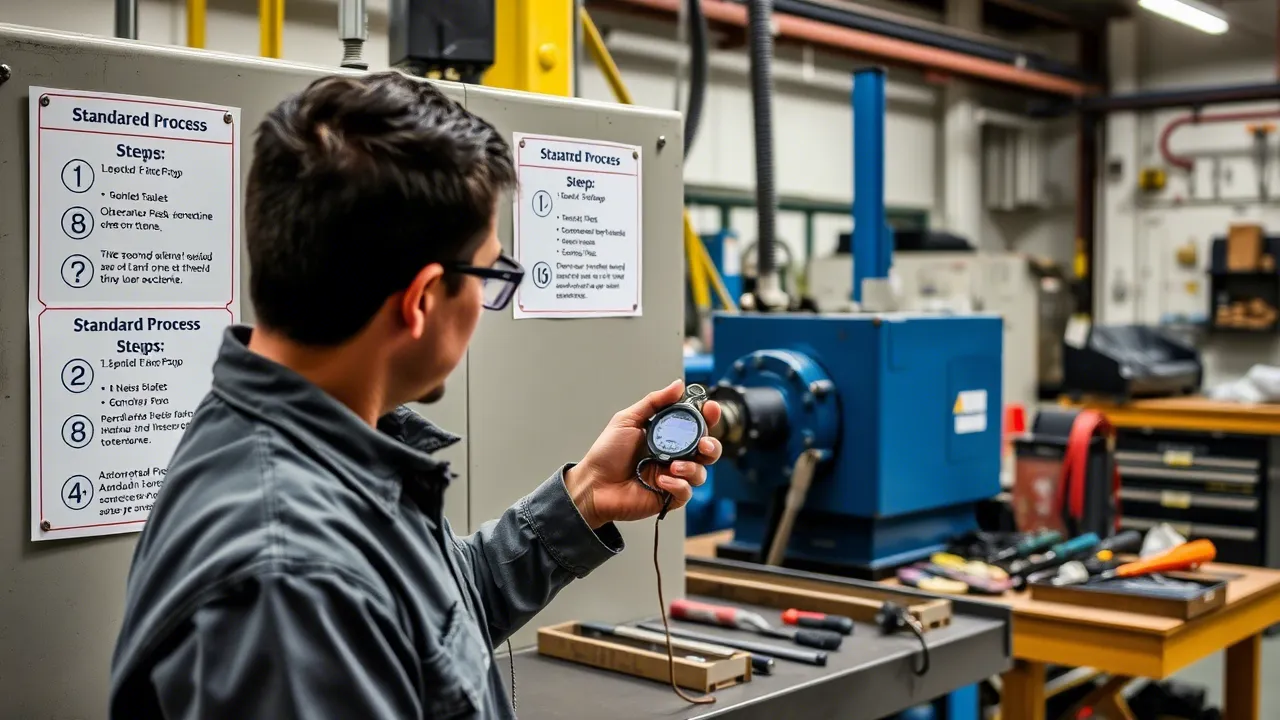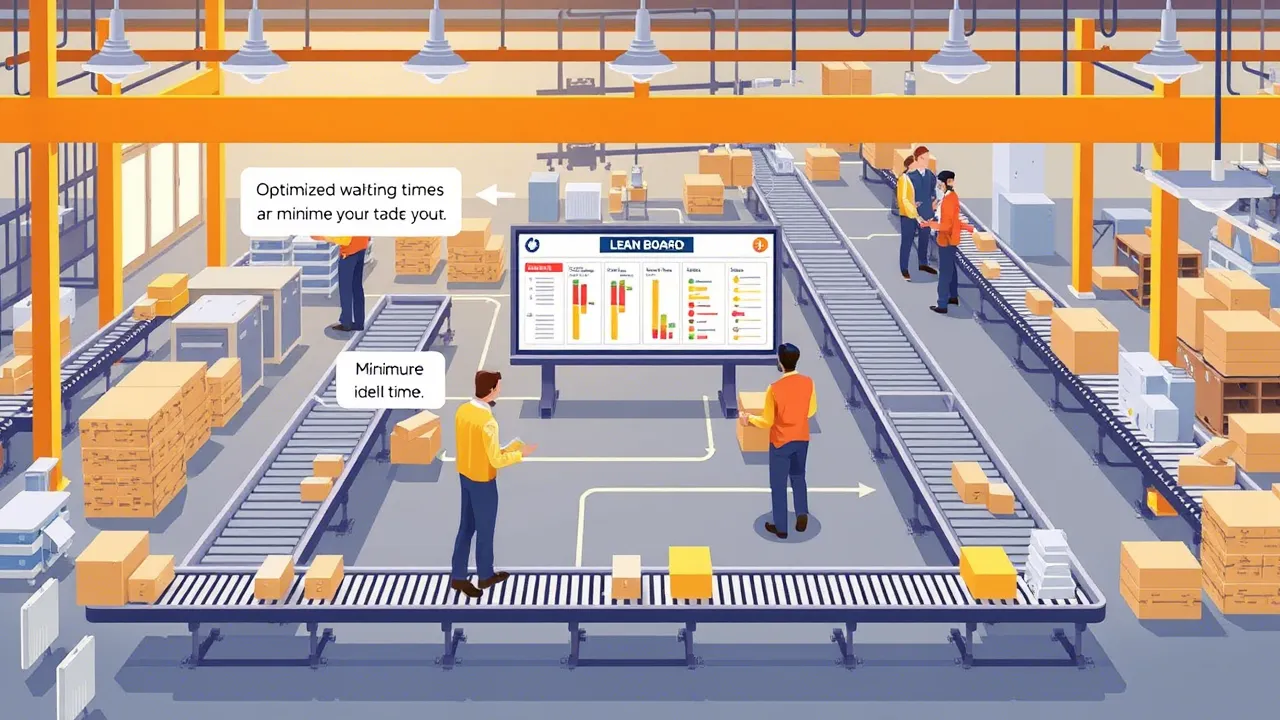
Methods engineering in the chemical industry (pharmaceuticals, petrochemicals, paints, APIs) faces a structural reality very different from discrete manufacturing. While on an automotive assembly line the pace is set by takt time or the operator's speed, in a chemical plant the cycle time is frequently dictated by thermodynamics and reaction kinetics.
This technical article breaks down how to approach work measurement in environments where "speeding up" may mean compromising safety or product quality, and where the real optimization opportunities lie through Time Engineering.
The Process Paradox: Why Conventional Time Study Fails in the Chemical Industry
The most common mistake of the inexperienced time study analyst in the chemical sector is trying to measure the physicochemical transformation process with the same tools used for manual assembly.
Difference Between Technological Time and Manual Time
In Batch processes, we must radically distinguish two types of time within the cycle:
- Technological Time (Machine/Process): Governed by variables such as heat transfer, pressure, agitation speed and the chemical reaction. It is inelastic to direct human action once it has started.
- Manual Time (Operational): Loading, unloading, cleaning, sampling and palletizing tasks.
The paradox lies in the fact that, although Technological Time usually accounts for 60-70% of the Lead Time, financial efficiency (OEE) depends almost exclusively on the meticulous management of Manual Time during transitions. Attempting to "time study" a 4-hour polymerization reaction adds no value; optimizing catalyst loading to reduce it from 45 to 30 minutes does.
Raw Material Variability and the OIT Standard
Unlike a machined screw with micron-level tolerances, chemical raw materials (solvents, resins, powders) have intrinsic variability. The viscosity of a fluid changes with ambient temperature, and the purity of a reagent alters the reaction rate.
According to OIT (International Labour Organization) standards, a fixed standard time cannot be established for a process whose duration depends on stochastic factors not controllable by the operator. In these cases, the standard must be defined through tolerance ranges or variable formulas linked to the recipe, something advanced tools such as Cronometras make it possible to model through time studies with parametric variables.
Measurement Methodologies: From the Stopwatch to Statistical Sampling
Since continuous observation is inefficient in 8-hour cycles, modern methods engineering must pivot toward statistical and predictive techniques.
Work Sampling (Activity Sampling)
To assess workload at reactor monitoring stations or control rooms (DCS), continuous time study is a waste of resources. The correct technique is Work Sampling.
This methodology consists of performing random observations to determine the percentage of time the operator spends on:
- Productive Activity (Direct intervention).
- Active Monitoring (Reading parameters).
- Process Waiting (Technical inactivity).
To guarantee data validity with a 95% confidence level and a margin of error of ±5%, it is essential to abandon paper forms. The use of specialized applications such as WorkSamp enables engineers to carry out digital sampling rounds, automatically calculating the required sample size ($n$) and generating real-time saturation heat maps.
Predetermined Time Systems (MTM-2 / MOST)
For repetitive and "blind" manual tasks (where the pace depends on the operator), the use of the stopwatch can introduce subjectivity into performance rating (Activity).
The application of systems such as MOST (Maynard Operation Sequence Technique) is the gold standard for:
- Inbound logistics: Bag cutting, emptying into hoppers, connecting hoses and flanges.
- End of line: Manual packaging, labeling and palletizing of drums.
The use of predetermined times eliminates discussion about the "normal pace" with works councils, since it is based on international standards of biomechanical movement.
Validation with SCADA/MES and OEE
Toward the 2025 horizon, work measurement must be audited against digital reality. The analyst must cross-reference their observations with the Time Stamps of the SCADA system. If the time study indicates that "Valve Opening" takes 30 seconds, but the Induly system (specialized in production control and OEE) records an average of 45 seconds over the last 100 batches, there is a hidden deviation (probably a micro-stop or an undetected ergonomic difficulty).
Saturation Calculation and Man-Machine Charts in Batch Processes
The critical KPI for plant management is not only how long the batch takes, but how many reactors one person can operate simultaneously.
Interference Analysis
The calculation of the optimal number of machines ($N$) that an operator can tend is governed by the relationship between total cycle time and manual service time + travel time.
However, in large-scale chemical plants, the term is critical. Safety distances and transit protocols in ATEX zones increase these times.
Market data suggest that real operational saturation in chemical plants is usually around 35%-45%. The rest is "monitoring". The challenge of methods engineering is to transform that passive monitoring into value-added tasks (preparation of the Next Batch, in-line quality control) without generating interferences that stop the critical process.
The lack of a human "acknowledgment" on a control panel can stop a reaction. These micro-stops, often invisible in manual reports, are effectively captured by automatic monitoring systems such as Induly, making it possible to isolate the efficiency loss due to lack of operator attention.
OIT Regulations and Rest Allowances in Hazardous Environments
This is the point where most time studies fail legally. An analyst cannot apply a standard rest allowance (K) of 4-5% (typical of light assembly) in a chemical plant.
Impact of PPE and Thermal Stress
The chemical plant operator frequently works with:
- Chemical protective suits (Type 3, 4 or 5).
- Respiratory protection masks (Half-face or full-face).
- High-thickness butyl/nitrile gloves.
These elements drastically increase metabolic expenditure and resistance to movement. In addition, in zones with exothermic reactors, thermal stress is a major risk factor.
Technical Recommendation: According to OIT tables and the Metabolic Rate methodology, fatigue allowances under these conditions must range between 12% and 20%. Ignoring this not only distorts the standard time, but also breaches occupational safety and health agreements (CGIQ), exposing the company to penalties.
OEE Optimization through SMED in Reactor Cleaning
The greatest Availability loss in Batch processes is cleaning and changeover (Changeover). This is where the SMED technique (Single-Minute Exchange of Die) must be applied rigorously.
- Reduction of Cleaning Times: Analyze through video analysis (a key feature of Cronometras) the movements during CIP/SIP or manual cleaning of reactors.
- Internal to External Conversion: Is the operator looking for tools or cleaning solvents after the reaction has finished? All of that must be prepared externally while the reactor is still producing.
- Standardization: Create visual work instructions for the disassembly of filters and piping.
The objective is to maximize Technical OEE. An OEE of 85% is world class, but many chemical plants operate at 60% due to inflated and non-standardized cleaning times.
Frequently Asked Questions about Time Engineering in the Chemical Sector
Is the MTM system applicable to a chemical reaction? Not to the reaction itself (technological process), but it is indispensable for all peripheral human tasks (loading, unloading, cleaning, palletizing) to set objective standards.
How is the standard time calculated if the reaction varies with ambient temperature? The standard time must be defined as a parametric function in the ERP, not as a fixed scalar. Correction tables based on historical data must be established.
What saturation percentage is acceptable for a chemical plant operator? Due to the criticality of safety and the need for rapid response to alarms, exceeding 75-80% saturation is not recommended. 100% saturation implies that any deviation will result in waiting times in the reactors.
How to integrate DCS/SCADA data into the time study? Do not rely solely on the stopwatch. Use platforms such as Induly to obtain the "process truth" and cross-reference it with sampling studies carried out with WorkSamp to obtain the "human truth". The intersection of both data sets is where real productivity resides.
Don't want to do it yourself? We do it for you from €800
If you prefer to outsource it, Cronometras delivers a complete time and motion study from a single video: elemental breakdown, OIT/TAL fatigue allowances, standard time with tolerances, and a report in PDF + Excel + JSON ready to present to management.