The Evolution of Work Measurement in Industry 5.0
The transition to Industry 5.0 has radically redefined work measurement. The industry no longer demands only a static "Standard Time" archived in a spreadsheet; modern operations require a dynamic data ecosystem capable of integrating seamlessly with MES (Manufacturing Execution Systems) and ERP systems.
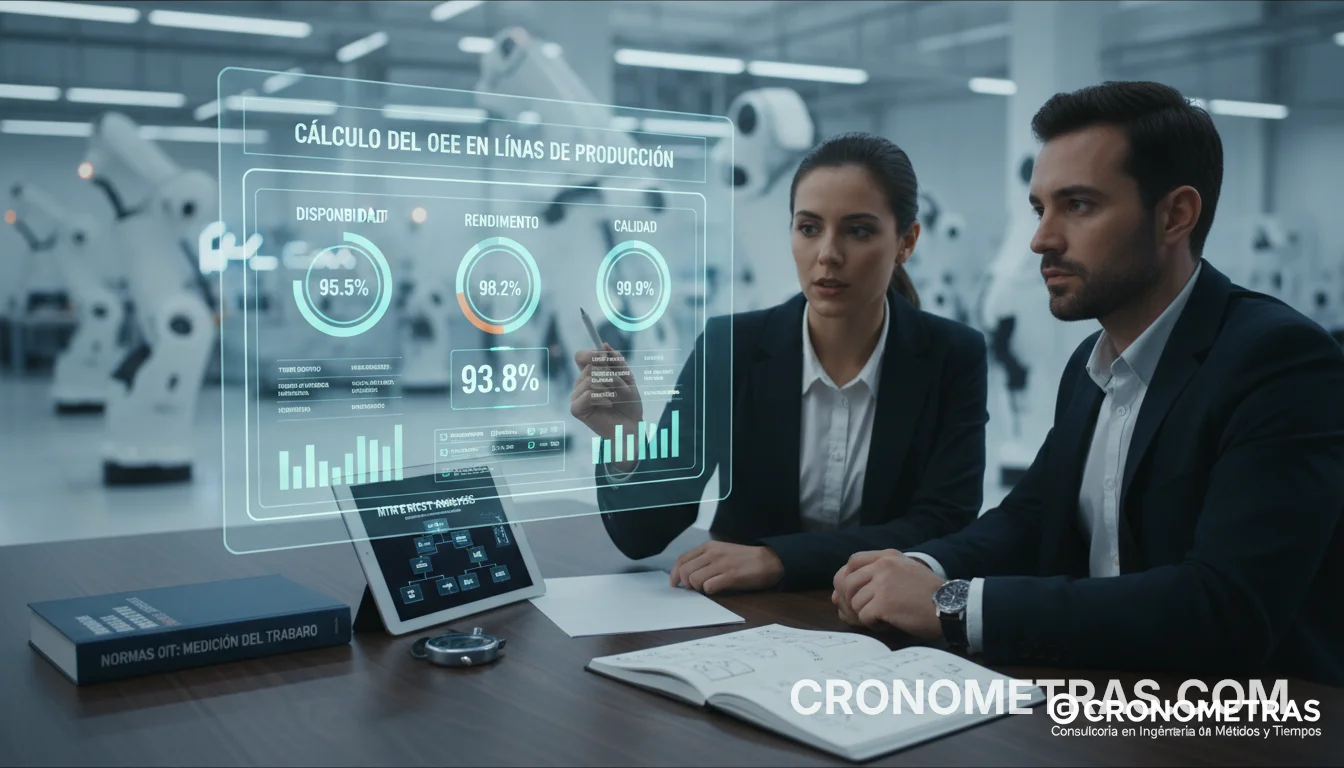
The current problem in the productive fabric is alarming: market studies confirm that 68% of industrial plants show a gap of more than 15% between the theoretical Standard Time and the actual Cycle Time. This discrepancy destroys the reliability of the OEE (Overall Equipment Effectiveness) calculation and distorts production costs. In this scenario, time benchmarking — the analytical comparison between different lines, shifts, and plants — stands as the main vector for uncovering hidden inefficiencies.
To digitize and monitor this data flow on the shop floor, tools such as Induly, an advanced Production Control and Industrial Time & Attendance software, are key to cross-referencing theoretical times with profitability in real time and to automating the OEE calculation without latency.
2025 Regulatory Framework and ILO Guidelines on Industrial Time Study
The regulatory environment has evolved, bringing technical productivity together with occupational health and union legality.
Algorithmic Transparency and Time Auditing
The requirements of labor legislation on performance measurement impose total transparency. A purely observational time study system that applies performance ratings based on traditional scales (such as the Bedaux scale or the British Standard) without robust technical justification is highly vulnerable from a legal standpoint. Works councils demand to know the parameters behind the calculation of the production bonus.
This is where the objectivity of predetermined time systems (MTM, MOST) lies, as they provide a mathematical and standardized basis against possible union litigation.
Ergonomics, Breaks, and Fatigue Allowances
Labor Inspection today focuses on the prevention of Musculoskeletal Disorders (MSD). For this reason, the process engineer must apply strictly and transparently the allowances for fatigue and personal needs laid down by the International Labour Organization (ILO).
In addition, recent regulations on digital disconnection and postural hygiene require the inclusion of visible microbreaks. Their mathematical impact on the net Available Time is direct, modifying the denominator in the OEE calculation and forcing a rethink of line balancing.
Operator Benchmarking and Time Variability Analysis
Isolating Method Dispersion vs. Pace Dispersion
Internal benchmarking must be demystified: the objective of learning what a time study is and its objectives is not to penalize the slowest operator, but to standardize the optimal process.
Variability analysis requires isolating the origin of the standard deviation ($\sigma$) in the timed cycles. The analyst must technically differentiate between:
- Method Dispersion: Variations in the sequences of micromovements (e.g., complex grasps, long reaches). Going deeper into Therbligs analysis in fine assembly is fundamental to isolating the skill and ergonomics of the workstation.
- Pace Dispersion: Differences in the physical effort applied under the same method.
Identification of Micro-Stoppages and Real OEE Losses
A common mistake of the novice analyst is to dilute micro-stoppages (minor jams, occasional material shortages, re-setups) within Basic Time. These interruptions of less than one minute must be classified and segregated, since they represent chronic speed losses.
To audit and isolate this type of unstructured stoppages, the use of scientific applications such as WorkSamp, designed for Work Sampling (Work Sampling) studies, allows engineers to statistically map the distribution of working time and identify these operational losses without the need for continuous time study.
Technical Comparison: Observational Time Study vs. Predetermined Systems
To establish robust standards, the market demands an intelligent hybridization of measurement techniques.
Limits of Conventional Time Study and Performance Rating
Industrial time study by direct observation, usually measured in hundredths of a minute (cmin), constantly clashes with the barrier of subjectivity. Market studies by the Consulting Division of Cronometras show that uncalibrated analysts can generate deviations of up to $\pm$12% when rating the activity of an operator.
Ideal use cases: This method remains cost-effective in very long cycles, machining processes, SMED studies for changeover time reduction, and tasks with a high inherent variability that prevents micrometric standardization.
Accuracy and Cost-Effectiveness of MTM and MOST Systems
Compared with observation, the MTM and MOST systems measure in TMU (Time Measurement Unit, where 1 TMU = 0.036 seconds) and embed a normal performance pace (100% target). Their rigor forces method improvement, reducing systemic variance to barely $\pm$5%.
Ideal use cases: Mass assembly environments, highly repetitive tasks and, above all, the preventive design of lines in the industrialization phase (Should-Be models), where times must be calculated before the physical line exists.
Impact of Time Benchmarking on MES and ERP Planning
The cost of maintaining static data is extremely high: 40% of the deviations in production cost calculation (Costing) originate from outdated standard times.
There is a direct mathematical correlation with OEE. A poorly calculated Ideal Cycle Time (generally inflated by the empirical inclusion of inefficiencies) will distort the Performance factor.
Performance formula:
If the Ideal Cycle Time is artificially high, the indicator will show a false 100%, masking chronic speed losses in the plant. Establishing correct times through benchmarking also guarantees the fundamental ILO Principle: ensuring a normal pace, sustainable by a qualified worker, without incurring overexertion.
Best Practices in Methods Engineering: The Cronometras Solution
To resolve these discrepancies and guarantee the technical and legal viability of standard times, Cronometras proposes a comprehensive consulting and digitalization methodology:
Pre-Time-Study Method Auditing and Ergonomic Redesign
The technical premise is non-negotiable: "What has not been standardized cannot be measured". Before starting time capture through our software platform Cronometras (which includes Multi Chrono functionality and secure video analysis), our consultants audit the workstation, optimizing travel, balancing bimanual use, and designing Poka-Yokes that guarantee quality at the source.
Parametric Mapping Using MOST for HMLV Environments
For high-mix, low-volume (HMLV) product families, MOST sequence modeling (General Move, Controlled Move, Tool Use) can be applied. This technique eliminates the exhaustive timing of the complete cycle, achieving a 40% reduction in the industrial engineer's analysis time.
Creation of Synthetic Time Databases
Digitalization makes it possible to build parametric formulas and customized databases for the plant. This empowers the technical office to quote and budget new references without the need for physical measurements on the shop floor. External certification by the senior analysts of Cronometras provides the necessary neutrality to guarantee industrial peace in the face of union audits.
Takt Time-Based Line Balancing
Finally, the refined data from benchmarking feeds station balancing. The goal is to maximize the operator's technical saturation under strict ergonomic criteria, minimizing waiting times (Muda) and synchronizing the work cell with the end customer's Takt Time.
The benchmarking of time studies has ceased to be a mere statistical exercise and has become the pillar of competitiveness in Industry 5.0. Moving from subjective time study to an auditable model, integrated with MES and supported by advanced methods engineering, is the only path to uncovering the hidden productive capacity in your plant.
Don't want to do it yourself? We do it for you from €800
If you prefer to outsource it, Cronometras delivers a complete time and motion study from a single video: elemental breakdown, OIT/TAL fatigue allowances, standard time with tolerances, and a report in PDF + Excel + JSON ready to present to management.